
Easter Saturday Fish Fry
By Thomas Quinn
Saturday at the Tomb
Everyone remembers Good Friday and, of course, Easter Sunday. But what about the forgotten Saturday in between? Does anything interesting happen then? Actually, a critical meeting takes place. After the body is taken down from the cross on Friday, it’s wrapped in cloth and placed in a tomb. Then, on Saturday, the chief priests ask Pontius Pilate to post a guard at the entrance; they want to ensure that someone doesn’t fake a resurrection by swiping the body under dark of night. So, Pilate has a stone rolled in front of the tomb and guards are posted.
But wait a second! All this takes place the day after Jesus dies on the cross and is taken to the tomb. The body spends the first night in the tomb unguarded. So much for security. The Gospel leaves open the easy possibility that the body is indeed taken. Maybe there was nothing but a roll of linens in the tomb by the time it was sealed. Or maybe someone just invented the whole episode.
In any case, the priests’ plan doesn’t work. On Sunday morning the body is missing. The guards say they fell asleep while on post, which sounds pretty lame. But it doesn’t matter. A legend is born.
Rise and Shine
According to the Gospel of Mark, Mary Magdalene, Mary the mother of James, and Mary Salome come to the tomb early Sunday morning and discover the stone has already been rolled away. A young man dressed in white is inside, but he’s not Jesus. He’s never identified, but he tells them that the Lord has already risen and to inform the others. The women flee in fear. So, who is this guy and how did he move the stone without the guards seeing him?
Matthew’s version of the tale clears this up with a simple miracle—an angel moves the stone when the women drop by, and the guards pass out from fear like a couple of southern belles who get the vapors. In a third version of the episode, Luke has the women finding two men at the tomb. And while Matthew has the ladies running into Jesus as they flee the scene, Luke has him approaching them later that day. At first, they don’t recognize him. It’s not until they all break bread later that night that they suddenly realize who he is—and then he instantly vanishes! It reads like an episode of The Twilight Zone.
In a completely different fourth account, John claims Mary Magdalene goes to the tomb alone on Sunday morning and finds it empty—no angel. Mary immediately tells Peter and another disciple about the empty tomb, and they both see for themselves. It’s only when they leave and Mary stays behind, crying, that two angels show up and ask, “Woman, why are you weeping?” As if they didn’t know. Then she turns around, and there’s Jesus! But at first, she thinks he’s just the gardener. (Did everyone’s eyesight go bad that morning?) Later, she tells the others that Jesus has risen.
Go figure. This is the single most important event in the entire Christian religion—the resurrection of Jesus Christ—and his biographers still can’t get their stories straight. Yet everyone is supposed to accept these accounts as word-for-word sacred truth. Conveniently, we have four sacred truths to choose from.
Later, when Jesus is with his disciples, the one named Thomas says he finds this whole resurrection claim hard to believe. So, Jesus allows him to stick his hand into the holes in his body. Bleeech. The doubting Thomas is finally convinced, and probably grossed out as well.
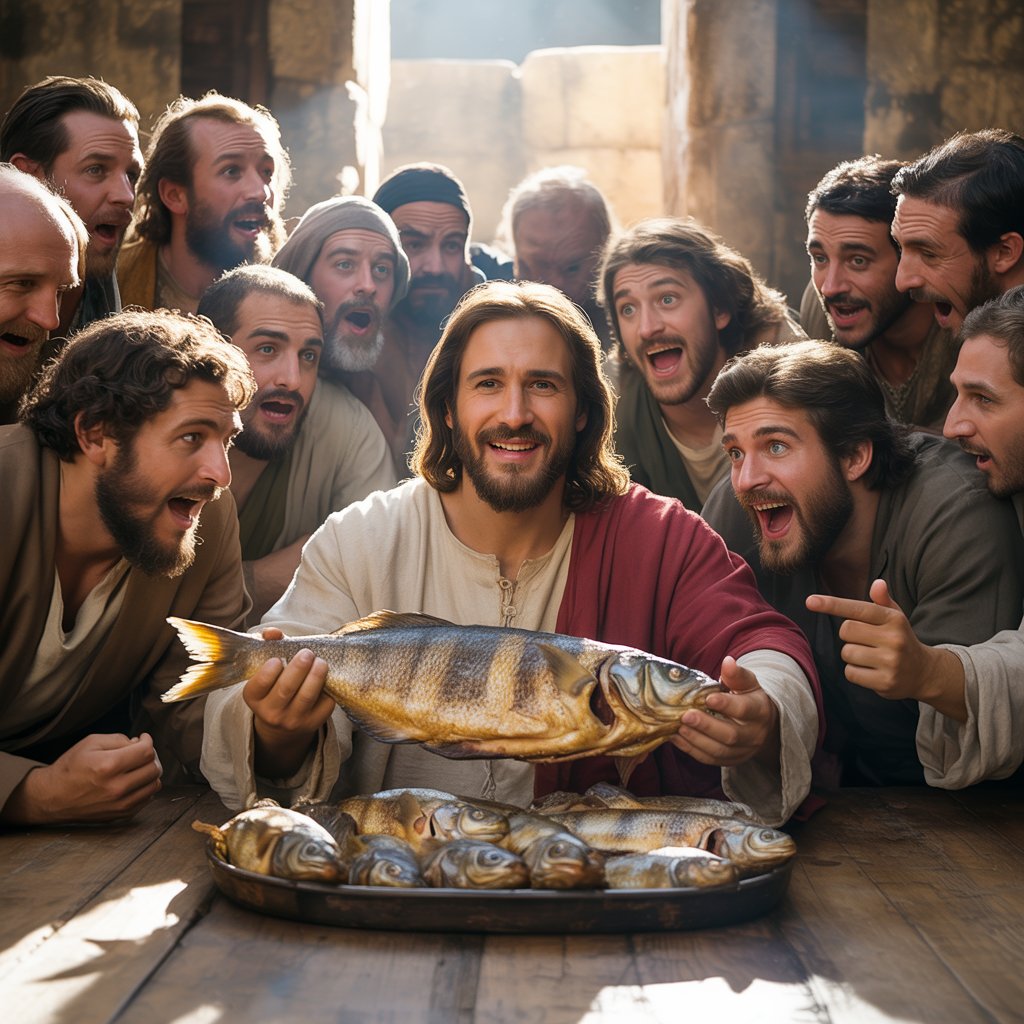
Then comes my favorite part. Luke reports that Jesus asks if they have anything to eat —and they gave him a piece of broiled fish. No kidding. He just rose from death and now he wants lunch. This moment is meant to drive home the point that he was raised up in body as well as spirit, which was a major theological issue in the early Christian centuries. Apparently, resurrection works up a roarin’ appetite.
Interestingly, none of the four Gospels have Jesus actually ascending to heaven. Mark’s story ends with the discovery of the empty tomb, though an extended version of that Gospel includes a few post-resurrection moments. Matthew ends with Jesus asking his disciples to preach to all nations. Luke concludes with Jesus blessing his followers, and then simply departing. Lastly, John has him saying “follow me,” but that’s it. No glorious exit scene. To tell you the truth, it’s pretty anticlimactic.
Luke, by the way, also has Jesus misquoting the Hebrew Bible. “Thus it is written, that the Christ should suffer and on the third day rise from the dead.” [Luke 24:46] Unfortunately, this is not written. Nowhere in the Hebrew Scripture is there a prediction of the Messiah’s resurrection on the third day. There’s no prophecy of his death and resurrection at all. Yet later, in the New Testament, Paul makes this same bogus claim in his letter to the Corinthians. [1 Corinthians 15:3-4] Kind of a major point to get wrong.
Leave a Reply
Want to join the discussion?Feel free to contribute!

Feel free to contribute.
https://www.facebook.com/groups/1878064359542775